
Choosing the right hospital bed is an important decision for medical equipment distributors. The products you select affect not only your purchasing costs but also your customers’ satisfaction, after-sales workload, and long-term business reputation.
With different hospital bed configurations, technical specifications, and supplier capabilities available, it can be difficult to determine which products are suitable for your target market.
A reliable purchasing decision starts with understanding your customers’ needs, comparing complete product specifications, and evaluating the manufacturer’s ability to deliver consistent quality.
This guide explains how medical equipment distributors can select suitable hospital beds, compare suppliers, and prepare a more effective purchasing plan.
1. Understand Your Target Market Before Choosing Hospital Beds
Before requesting quotations from hospital bed manufacturers, define the customers you want to serve.
Different healthcare facilities have different requirements. A hospital purchasing beds for a general ward may have different priorities from a nursing home, rehabilitation center, or private healthcare facility.
Identify Your Main Customer Segments
Consider the following questions:
- Are your customers public hospitals, private hospitals, clinics, or nursing homes?
- Do they primarily purchase basic manual beds or electric hospital beds?
- Are they looking for individual products, bulk orders, or complete hospital furniture solutions?
- Do they require local registration, specific product documentation, or customized configurations?
- What purchasing budget and after-sales support expectations do they have?
Understanding these requirements helps you avoid purchasing products that do not match your market.
Develop a Balanced Product Portfolio
For many distributors, a focused product range is easier to manage than a large catalogue of similar models.
A practical starting point may include:
- Basic manual hospital beds for cost-conscious customers.
- Electric hospital beds for facilities requiring convenient patient positioning.
- Nursing and home-care beds for long-term care applications, where suitable.
- Selected accessories and replacement parts to support existing customers.
The right product mix depends on local demand, available technical support, regulatory requirements, and your business strategy.
2. Compare Different Types of Hospital Beds
Hospital beds are available in different configurations. Understanding their functions and intended applications is essential before comparing prices.
Manual Hospital Beds
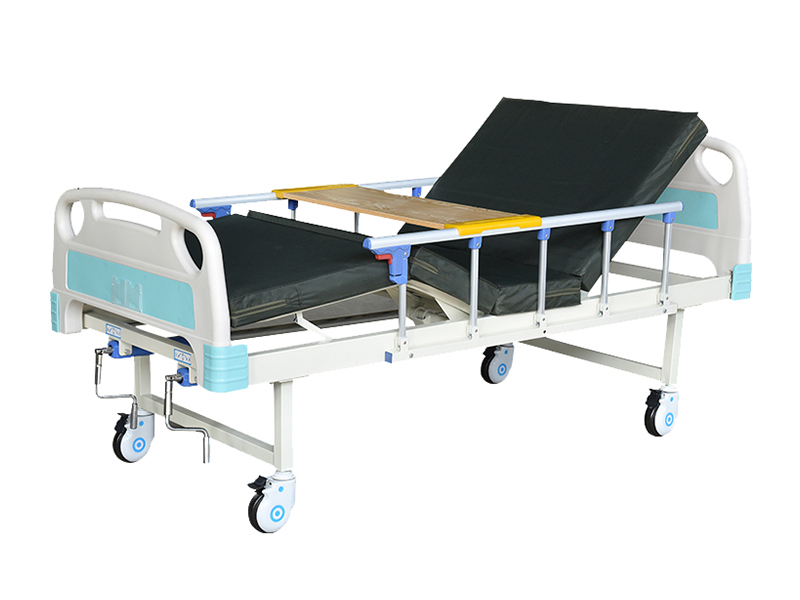
Manual hospital beds use mechanical cranks to adjust selected bed positions.
They may be suitable for general wards, clinics, and healthcare facilities seeking a relatively simple bed configuration.
Key purchasing considerations:
- Number and type of adjustment functions.
- Crank operation and accessibility.
- Frame construction and mechanical components.
- Side rails, casters, and braking system.
- Availability of replacement parts.
For distributors, manual beds may be a useful option in markets where purchase price, straightforward operation, and maintenance capability are important.
Electric Hospital Beds
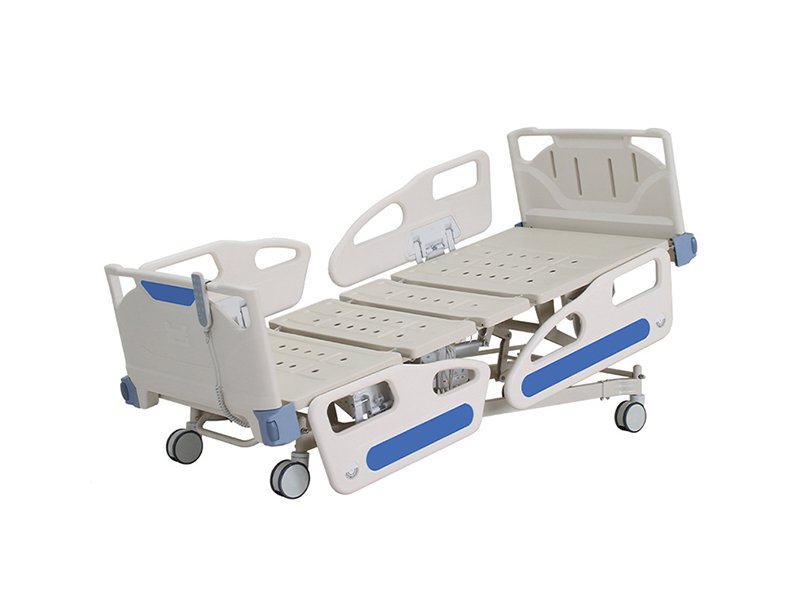
Electric hospital beds use electric actuators to adjust selected bed positions.
Depending on the model, these functions may include backrest adjustment, knee-rest adjustment, and bed-height adjustment.
Key purchasing considerations:
- Exact functions controlled by the motors.
- Motor and control-system specifications.
- Local voltage, frequency, and plug requirements.
- Emergency lowering or manual override, if applicable.
- Availability of technical support and replacement motors.
Electric beds may be attractive to customers who prioritize convenient positioning and reduced manual adjustment by caregivers.
Specialized Hospital Beds
Specialized beds may be designed for particular patient groups or clinical environments, such as intensive care, pediatric care, or bariatric care.
These products may require additional safety features, specialized dimensions, higher load capacities, or specific clinical functions.
Distributors should confirm the intended use, applicable safety requirements, and actual manufacturer capabilities before adding specialized products to their portfolio.
Important: Product names and function counts are not standardized across all manufacturers. Always compare the exact functions and specifications of each model.
3. Check the Key Hospital Bed Specifications
A hospital bed should be evaluated using a complete technical specification sheet rather than product photographs or a model name alone.
Dimensions and Safe Working Load
Confirm the overall bed dimensions, mattress platform dimensions, and required clearance around the bed.
For electric models, also consider the space needed for movement, maintenance, and access to electrical components.
Ask the manufacturer to specify the safe working load and explain the applicable rating. Do not assume that safe working load, patient weight capacity, and static load are interchangeable.
Bed Functions and Adjustment Range
Request a clear list of every adjustment function.
For example, an electric bed may provide backrest, knee-rest, and height adjustment. Other models may offer additional positioning functions.
Confirm the adjustment range, operating method, and whether each function is included in the quoted configuration.
Frame, Side Rails, and Casters
The bed frame, side rails, and casters affect daily usability and maintenance.
Ask about:
- Frame material and surface treatment.
- Side-rail design, locking mechanism, and compatibility.
- Caster diameter, material, and braking arrangement.
- Cleaning and maintenance requirements.
- Availability of replacement components.
Where patient safety is concerned, request appropriate test evidence and confirm that the bed is suitable for its intended use.
Mattress and Accessories
Do not assume that a mattress, IV pole, lifting pole, or other accessory is included in the bed price.
Ask the supplier to identify each included and optional item.
Confirm mattress dimensions and compatibility with the bed platform, side rails, and intended application.
Electrical Components
For electric hospital beds, request details about the motors, hand controller, power supply, cable arrangement, and electrical protection features.
Check compatibility with the destination country’s electrical supply.
Any claimed safety features or performance specifications should be supported by the manufacturer’s technical documentation.
4. Compare Hospital Bed Suppliers Beyond Unit Price
A low quotation does not necessarily represent the best purchasing decision.
Two hospital beds may look similar but differ in materials, components, included accessories, packaging, and after-sales support.
To compare suppliers fairly, use the same specification and commercial requirements for every quotation.
Request a Complete Quotation
Your quotation request should include:
| Information | What to confirm |
|---|---|
| Product | Exact model and configuration |
| Quantity | Order quantity and product mix |
| Accessories | Included and optional items |
| Pricing | Unit price and quotation validity |
| Shipping | Packing dimensions, gross weight, and CBM |
| Delivery | Production lead time and shipment schedule |
| Commercial terms | Currency, Incoterm, and payment terms |
| Support | Warranty, spare parts, and technical assistance |
This information allows you to compare quotations on a consistent basis.
Evaluate the Manufacturer’s Production Capabilities
If you are purchasing directly from a factory, evaluate whether the manufacturer can consistently produce the products you intend to sell.
Consider reviewing:
- Production equipment and manufacturing processes.
- Incoming material inspection.
- In-process quality control.
- Final inspection and functional testing.
- Product traceability and quality records.
- Production capacity and order scheduling.
A factory visit or live video audit can help you understand the actual production process.
Request Product Samples When Appropriate
For a new supplier or unfamiliar model, a sample can help you evaluate product quality and usability before placing a bulk order.
Define the sample approval criteria in advance, including the model, configuration, appearance, functions, accessories, and required documents.
The approved sample should become a reference for subsequent production and inspection.
5. Verify Quality and Regulatory Documentation
Hospital beds are medical devices or medical equipment whose regulatory status depends on the product and destination market.
Before placing an order, determine which documents are required for importing, distributing, and selling the specific model in your target country.
Check the Manufacturer’s Quality Management System
Ask whether the manufacturer maintains a quality management system appropriate to the product.
Where applicable, request the relevant ISO 13485 certificate and verify its validity, scope, issuing body, and covered manufacturing site.
A quality management certificate is not a substitute for product-specific regulatory approval or conformity evidence.
Review Product-Specific Documents
Depending on the product and destination market, relevant documents may include:
- Product specifications and user manuals.
- Applicable test reports.
- Declaration of Conformity, where required.
- Product labels and identification information.
- Electrical safety and electromagnetic compatibility documentation for applicable electric models.
- Registration or import authorization documents, where required.
For European markets, confirm the applicable EU medical-device regulatory requirements and conformity-assessment route for the exact product.
Do not assume that a CE mark or a general company certificate automatically authorizes a product for sale in every country.
Confirm Applicable Safety Standards
Ask the manufacturer to identify the standards and editions applicable to the selected bed.
For medical beds, relevant standards may include the IEC 80601-2-52 series, depending on the bed’s intended use and classification.
The applicability of a standard should be confirmed against the product’s design, intended use, and destination-market requirements.
6. Calculate the Total Landed Cost
For distributors, the purchasing cost includes more than the factory price.
A complete cost calculation helps you estimate the investment required and determine a sustainable resale price.
Consider All Major Cost Components
Your landed-cost calculation may include:
- Product purchase price.
- Export packaging and handling.
- Inland transportation.
- Export customs clearance and documentation.
- International freight.
- Insurance, where applicable.
- Destination port and import-related charges.
- Import duties and taxes, where applicable.
- Local transportation and warehousing.
- Expected after-sales and spare-parts costs.
The exact costs depend on the destination country, shipment method, Incoterm, product configuration, and order quantity.
Confirm Packing Dimensions and Container Loading
Hospital beds can occupy substantial shipping volume, so packaging and loading efficiency may significantly affect the final cost per unit.
Ask the supplier to provide the packed dimensions, gross weight, and CBM for each model.
Confirm whether the beds will be shipped assembled or in a knock-down configuration. Review the packing method, protection of vulnerable components, and assembly requirements.
Do not rely on estimated container quantities until the final packaging dimensions and loading arrangement have been confirmed.
7. Plan After-Sales Service and Spare Parts
After-sales support is an important consideration for medical equipment distributors.
A reliable support plan can help reduce customer complaints and protect your business reputation.
Confirm Warranty Terms
Ask the manufacturer to provide written warranty terms covering:
- Warranty period and start date.
- Covered components and defects.
- Exclusions and responsibilities.
- Claim submission and evidence requirements.
- Repair, replacement, or compensation arrangements.
The final warranty terms should be agreed in writing before the order is placed.
Prepare a Spare-Parts Plan
For electric beds, consider whether you need replacement motors, controllers, cables, or other model-specific components.
For manual beds, consider the availability of mechanical components, cranks, casters, and hardware.
The spare-parts plan should reflect the products you sell, the installed customer base, and the technical support available in your market.
8. Consider OEM Hospital Beds for Your Distribution Business
OEM purchasing can help distributors develop a product range that better matches their local market and brand positioning.
Depending on the manufacturer’s actual capabilities, customization may include:
- Company logo and product labels.
- Selected colors and appearance.
- Approved product configurations.
- Packaging and documentation.
- Other agreed design or accessory requirements.
Confirm Customization Feasibility Before Ordering
Not every customization request is suitable for every bed model.
Before confirming an OEM order, clarify the design requirements, minimum order quantity, development costs, sample approval process, production schedule, and ownership of customized materials or designs.
Any modification that affects product safety, performance, or regulatory status should be reviewed appropriately before production.
For distributors, the best OEM arrangement is one that creates a clear market advantage while maintaining product consistency and regulatory compliance.
Conclusion: Choose a Hospital Bed Supplier That Supports Your Business
Choosing the right hospital bed involves more than comparing product photographs and unit prices.
For medical equipment distributors, a successful purchasing decision requires a clear understanding of customer needs, complete technical specifications, reliable manufacturing, appropriate documentation, competitive landed costs, and dependable after-sales support.
By establishing a consistent supplier evaluation process, you can make better purchasing decisions, reduce avoidable risks, and build a more competitive medical equipment portfolio.
Whether you are sourcing manual hospital beds, electric hospital beds, or customized products for your distribution business, begin with a clear specification and a supplier who can explain the details behind the quotation.
Request a Hospital Bed Quotation for Your Distribution Business
Are you looking for a hospital bed manufacturer or supplier for your local market?
At ZIBO CHENGCHUAN MEDICAL DEVICE CO., LTD, we welcome inquiries from international medical equipment distributors, importers, and OEM partners.
Share your purchasing requirements with our team so we can review the appropriate product options and prepare a quotation based on your needs.
To help us respond efficiently, please provide:
- Destination country or market.
- Required hospital bed type and configuration.
- Estimated order quantity.
- Required accessories and customization.
- Applicable certification or documentation requirements.
- Preferred delivery schedule.
Contact our team to discuss your hospital bed sourcing requirements and explore a potential distribution partnership.
Request a quotation
Send us your requirements for a model-specific quotation.
FAQ: Frequently Asked Questions About Hospital Bed Purchasing
1. What type of hospital bed should a distributor purchase first?
Start with the bed types most relevant to your existing customers. Manual and electric hospital beds may serve different market segments, so evaluate local demand, purchasing budgets, maintenance capabilities, and regulatory requirements before selecting your initial product range.
2. What information should I provide when requesting a hospital bed quotation?
Provide the destination country, required model or functions, estimated quantity, accessories, documentation requirements, delivery schedule, and any OEM requirements. This helps the supplier prepare a more accurate quotation.
3. How can I compare hospital bed manufacturers?
Compare manufacturers using the same product specifications. Evaluate production capabilities, quality-control procedures, relevant product documentation, sample quality, packaging, delivery commitments, and after-sales support—not just unit price.
4. Is a higher-function hospital bed always better?
No. The appropriate configuration depends on the intended application and customer requirements. Additional functions may increase the purchase price and maintenance complexity without providing meaningful value for every customer.
5. Should I request a product sample before placing a bulk order?
For a new supplier or unfamiliar model, requesting a sample is a useful way to evaluate the product against agreed specifications. For large or customized orders, establish written sample-approval and production-inspection criteria.
6. What is the difference between safe working load and patient weight capacity?
These terms should not be assumed to mean the same thing. Ask the manufacturer to define the load rating for the exact model and identify the applicable testing basis. Confirm the intended patient weight limit separately where required.
7. What should I check when purchasing electric hospital beds?
Confirm the adjustment functions, electrical specifications, motor and controller details, safety documentation, mattress compatibility, and replacement-part availability. Ensure that the electrical configuration is suitable for the destination market.
8. Can hospital beds be customized with my company logo?
OEM customization may be available depending on the manufacturer’s capabilities and the selected model. Confirm the available options, minimum order quantity, sample approval process, additional costs, and any regulatory implications before placing an order.